
It is time to throw an outer ring around India's national security by proactively engaging in areas immediately outside our neighbourhood. Such a ring will not only insulate India from emerging threats, but also create new leverage in securing our own neighbourhood, says Nitin Pai.
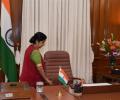
Sushma Swaraj, like Clinton, has a strong political base in her own party and is likely to have her imprint on foreign policy, says Ambassador T P Sreenivasan.

By deeming October 31, Sardar Vallabhai Patel's birthday as Rashtriya Ekta Diwas, the BJP has rightly made amends for the short shrift that the great leader received at the hands of the Congress. By the same token, the BJP cannot be seen as being petty towards Indira, a leader who despite her flaws, did render yeoman service to the nation, says Vivek Gumaste.

Beijing wants assurance that its investments won't come under scrutiny
.jpg)
Throughout a quarter century of proxy war, India has shown tremendous restraint in the face of grave provocation. It is inconceivable that any other nation would have refrained from launching trans-LoC operations to eliminate terrorist training camps and interdict known routes of infiltration, says Brigadier Gurmeet Kanwal (retd).
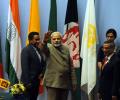
'If his three priorities are the economy, the economy, the economy, then there is need for a stable region, a stable neighbourhood.'
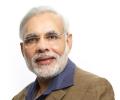
The major driver of Mod's foreign policy can be gauged from his economic priorities such as creating employment opportunities for the youth bulge. Related to this is emphasis on manufacturing, and infrastructure development, which in turn raises the issue of FDI. He has already articulated his views on all these issues, says Rup Narayan Das.

'Clearly, from the Indian viewpoint, the US retrenchment from Asia cannot be happening as good news.' 'The abandonment of the US' pivot to Asia exposes the US-Indian partnership to be a mere transactional relationship,' says Ambassador M K Bhadrakumar

'We're going to see a defence relationship that really takes off -- now that India is a major defence partner of the US, the sky is the limit for arms sales.' 'The economic partnership will lag behind the security relationship, but the meeting and joint statement give cause to believe that it will progress more robustly than many of us would have expected.'

'With the recent challenging of the notion of the Indian Ocean Region being India's strategic backyard, China is gradually upping the ante in the maritime realm around India.'

To persist with talks in the face of continuing terrorism that puts hundreds of Indian lives at stake is not only naive but morally repugnant and ethically unacceptable. It is time to see through this charade and abandon a path of high risk and no returns, says Vivek Gumaste.

The US needs to do three things to help the newly elected Nawaz Sharif government in Pakistan, says Stanley A Weiss
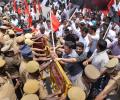
Protester Sasi Perumal's death has given a new fillip to the pro-prohibition movement, which was beginning to draw attention across Tamil Nadu after different political parties began to make it a part of their poll manifesto for next year, says N Sathiya Moorthy.

'Soon enough, we were out shouted. The journalist had a multiple agenda -- he berated the Government, the bureaucracy in general and the UPSC system that selected them.'

A very delayed and subdued reaction, at a time when the non-aligned world had expected a big country like India to come out in support of rights and justice. It was yet another example of the mealy mouthed approach that has come to define Indian foreign policy, says Seema Mustafa.

With the launch of the first indigenous aircraft today, India will join a club of nations like the United States, Russia, China, the United Kingdom and France that possess nuclear-powered submarines

Monisha Dudaney tells you what the stars predict for the coming months.

On the occasion of Chinese New Year, we bring you a look at what 2015, the Year of the Sheep has in store for you!

No account of the 1962 war could be complete without Maxwell's authoritative analysis. Which is why we are reprinting this article which was run on Rediff.com in June 2001.

The ordinary life lived in Pakistan is rarely a part of Indian imagination. This is this gap that Pakistani television serials have succeeded in bridging, says Mohammad Asim Siddiqui.
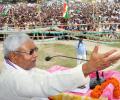
Bihar Chief Minister Nitish Kumar attacks the BJP, saying that its only intention is to capture absolute power.

Dr Swarnim Wagle, the official behind Nepal's reconstruction strategy, speaks to Patrick Ward.

'Whether it's investments in Kashmir, building naval facilities, or selling top-of-the-range military equipment, Pakistan could well benefit more under Xi's watch.' 'Do Chinese concerns about the 'Islamisation' of Pakistan give it pause about how quickly to move forward with security and economic projects? At the moment the indication is quite the opposite: China is doubling down on its support to Pakistan, partly because of its fears about where the country is headed.'
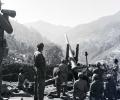
Fifty years ago, India and Pakistan fought a short but bloody war. The author finds out how Sainik Samachar, the defence ministry's journal, reported it.

'What gives hope is that Modi's own leadership is vitally linked to his capacity to deliver on the economic front. Indeed, if he succeeds, India's foreign policies will have changed beyond recognition,' feels Ambassador M K Bhadrakumar.

Syriza lawmakers walked the corridors telling reporters the government might not survive the night.

A special episode of the Prime Minister's radio broadcast Mann ki Baat featuring US President Barack Obama and Prime Minister Narendra Modi was aired on Tuesday night. The 35-minute special broadcast of 'Mann Ki Baat', which marked the rapport between Modi and Obama, touched on issues ranging from public health and personal inspirations of the two leaders, both of whom have come up from simple beginnings to assume to top positions of the respective countries. What follows is a transcript of the Mann ki Baat episode.

'In the first meeting of this new year, we took a joint new year resolution that we will complete it this year. At the time things were not very clear, but the mood was clear that yes, we must resolve it.' 'Yes, details have to come out, but there are some sensitivities, there are some stake-holders not yet on board, especially other Naga undergrounds etc, we would like them to come on board... So at a proper time it has to be revealed to the country, and to the legislature. Perhaps, we may have to wait for some more time.' 'With better understanding of the Indian system, many of them have learnt, realised, appreciated that Naga nationalist aspirations can be accommodated in the Indian system. The Indian system is pretty comprehensive and flexible.' 'A Naga has as much stake, claim over India as any other Indian. There is no distinction. This, Nagas have realised, that yes, Naga nationalist aspirations and Indian nationalism are not mutually exclusive.' Ravindra Narayan Ravi, the Government of India's Special Interlocutor for the Naga talks, explains how the Naga Peace Accord was reached in an exclusive interview to Saisuresh Sivaswamy/Rediff.com

Read the full transcript of President Obama's State of the Union address on Wednesday at the US Capitol in Washington.
